Puccini in a Pub
OperaUpClose’s rough-edged, pub piano production of La Bohème exchanges 19th century Paris for modern day Islington, while still retaining Puccini’s power to move and shock.
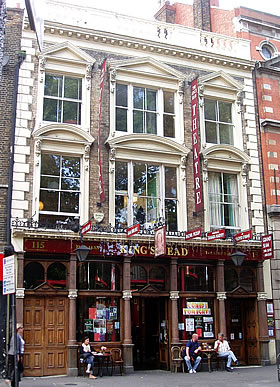 Now showing in the King’s Head Theatre-Pub, La Bohème, directed by Robin Norton-Hale, premiered above a drinking den in Kilburn. This low-budget production beat five international companies to win this year’s Olivier prize for best new opera.
Performed in the vernacular and with a libretto referencing Angel, where “spices from curries float down on the breeze from alleys,” Puccini’s story of young adults trying to find themselves gained a breath of beery air by being transferred to a bedsit in bohemian Islington.
There was no need to change job titles with the setting. Rodolfo (Anthony Flaum) remained a writer, Marcello (Tom Kennedy) an artist and Colline (Dickon Gough) a philosophy lecturer. Their garret became a student bedroom where paintings and fairy-lights jostled against clotheshorses laden with socks.
The production avoided making Mimi’s (Elinor Moran) death of tuberculosis anachronistic by presenting her as an illegal immigrant, too scared of deportation to seek help.
The singers, like the characters they represented, were in their twenties. Their voices were undeveloped but their youth lent truthfulness and life to this tale of first love and first loss.
Flaum and Moran proved natural singer-actors, their voices and bodies harmonising, first tentatively then beautifully, during “O soave fanciulla.” Moran’s soprano voice encompassed Mimi’s youthfulness and fragility as her coughing worsened, while Kennedy’s baritone gave authority and power to his Marcello.
OperaUpClose aims to undermine the popular impression of opera as an untouchable form. La Bohème certainly brought the audience close to the action. The bar of the King’s Head became the Café Momus and the audience found itself cast as drinkers. One audience member became a prop to help Musetta (Prudence Sanders), in a tight red dress, climb onto the bar to prevent Marcello missing her alluring “Quando me ‘n vo.” Marcello splashed another with his pint as, accompanied by cheers, he flung it down to embrace Musetta.
Norton-Hale explained she translated the libretto into English to enable audiences to understand La Bohème’s vivid and sometimes vicious humour without craning to read surtitles.
She said: “People remember Mimi’s death and forget all the humour in La Bohème.”
Mimi’s end, curled up on the sofa before an audience who saw her head droop even before Schaunard (Alistair Sutherland) whispered her demise, was certainly memorable. The small space made Rodolfo’s contorted face painfully visible as he absorbed the fact of her death. His two cries of “Mimi”, “Mimi!” – on the crest of a sob, then muffled in her chest – left few dry eyes.
Yet the audience left with the impression, not of sobbing, but of youths joking about a “steamy” novel as they burned Rodolfo’s masterwork on stage, or of them dancing and duelling with beanbags while referencing Strictly Come Dancing.
Despite its tragic end, Puccini’s opera has the light touch of high comedy, and OperaUpClose’s radical La Bohème realised this fully.

No comments:
Post a Comment