Saturday, 18 February 2012

An encounter with Jack the Ripper


I have just emerged from Tower Hill station into the gloom of a February evening. At the station entrance a crowd bunches around a man on a stool, hanging on his every word. I approach a woman hovering at the fringe. “What’s happening?” The man on the stool glares straight at me. “We’re here to follow the bloody footsteps of Jack the Ripper. Care to join us?”

Between August and November 1888, five brutal murders disturbed the Whitechapel area. The victims, who were prostitutes, were horribly mutilated. The killer, dubbed Jack the Ripper, was never found. A media sensation at the time, the killings continue to fascinate. Novelists and historians have come up with over 100 possible suspects, including the artist Walter Sickert and Queen Victoria's son the Duke of Clarence. Every night, numerous Jack the Ripper walking tours tread the murderer’s slashing ground, trying to unlock the truth behind the crimes. The one I have joined is led by Donald Rumbelow, ex-police officer, crime historian and a leading authority on Jack the Ripper, who has been doing guided tours with London Walks for 16 years. 

Rumbelow leaps off his little plastic stool and picks up his wheely shopping trolley, the kind favoured by old women. “It’s not full of body parts – I’ve got copies of my book in it.” Thirty people follow behind: a young couple on a birthday treat, teachers on half-term holiday, Americans, Poles, an unruly group of children.

Our first halt is under a fragment of the ancient wall encircling the square mile. Here Rumbelow describes the victims. “They were not glamorous, as shown in Johnny Depp’s From Hell. Most were women in their forties, living on the streets. Their faces were puffy from gin. These women cost two pence, less than the price of half a pound of cheese. The first victim, Mary Ann Nichols, had five front teeth missing, yet was convinced her new hat would attract enough money for a bed for the night.”

From there we plunge into the heart of the City of London, stopping at St Botolph’s of Aldgate, a brick church tipped with a spire. Now overshadowed by the Gherkin, the church, in the 19th century, was a prostitute’s roundabout. Rumbelow comments: “If they stood still, prostitutes could be accused of soliciting, so they walked round the church until a customer approached and led them down a dark alley. Catherine Eddowes, the fourth victim, was imitating a fire engine here on the night she died.” This raises a laugh; stilled when Donald leads us down our own dark alley into Mitre Square, where Eddowes was found.
The square is dark, scarcely illuminated by a fitful streetlamp, although only the cobbles are original. As the guide begins, in his measured yet dramatic way, to describe Eddowes’s death, I imagine the returning salesman who bumps his cart into something soft, huddled in the entrance of his yard. By a flickering candle he sees the body of a woman with her face slashed, her throat cut down to her spine, her internal organs thrown over her shoulder.

Tatiana, part of the young couple, grabs my arm: “I have to walk through Whitechapel at 6am, tomorrow; I’ll be terrified.” 

Crossing Middlesex Street, we reach the East End, where three of the women were killed. Here some of the houses, made from yellowish brick, four stories high, date from 1666

Ann Chapman, the second victim, was murdered among these terraces. Standing in the middle of Spitalfield’s Market, where she met the Ripper, I glimpse a shortish man in a wide-brimmed black hat and long black overcoat, carrying a brown bag. He matches the description of the murderer Rumbelow has given us. I experience a genuine frisson of fear. 

Just as Rumbelow is about to describe Ann Chapman’s death, the children begin giggling. One of the teachers suddenly explodes: “Could someone control these kids? I’ve been looking forward to this tour for months.” Donald looked bemused, “Where was I?” he says. Then thick black eyebrows unfurrow and he repeats the last two minutes of his account, verbatim, as if someone had rewound him, and pressed play. The atmosphere changes, details become less vivid. His description of Chapman’s death: “She was ripped from vagina to breast bone, her insides were thrown over her shoulder,” becomes formulaic. I notice my wet feet and the fact that I am freezing.

Even the last death, that of Mary Kelly, who was murdered and mutilated in her bed in Dorset Row, “the worst street in London,” fails to shock. Perhaps because there is nothing to see but for a multi-story car park. 

Next to us, in another tour, a figure posturing in a long ragged coat and flat cap wields a photograph of Mary Kelly’s mutilated body. Rumbelow describes them as: “Charlatans, who ignore the real history of East London life.” Their tour may be less historically accurate, but it certainly seems more fun.

Fact box: Jack the Ripper’s Victims
Victim 1. Mary Ann Nichols, 45. Killed August 31 on Buck’s Row. Disembowelled.
Victim 2. Anne Chapman, 45. Killed September 8 on Hanbury Street. Uterus removed
Victim 3. Elizabeth Stride, 44. Killed September 30, in Duffield's Yard, Berner Street. Throat cut.
Victim 4. Catherine Eddowes, 46. Killed September 30 in Mitre Square. Uterus and left kidney removed, cheeks torn.
Victim 5. Mary Kelly, 25. Killed November 9 on Dorset Street. Entire body mutilated;
heart removed.

Sunday, 15 January 2012

Puccini in a Pub


OperaUpClose’s rough-edged, pub piano production of La Bohème exchanges 19th century Paris for modern day Islington, while still retaining Puccini’s power to move and shock.
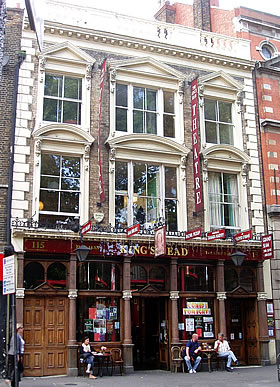
Now showing in the King’s Head Theatre-Pub, La Bohème, directed by Robin Norton-Hale, premiered above a drinking den in Kilburn. This low-budget production beat five international companies to win this year’s Olivier prize for best new opera.
Performed in the vernacular and with a libretto referencing Angel, where “spices from curries float down on the breeze from alleys,” Puccini’s story of young adults trying to find themselves gained a breath of beery air by being transferred to a bedsit in bohemian Islington.
There was no need to change job titles with the setting. Rodolfo (Anthony Flaum) remained a writer, Marcello (Tom Kennedy) an artist and Colline (Dickon Gough) a philosophy lecturer. Their garret became a student bedroom where paintings and fairy-lights jostled against clotheshorses laden with socks.
The production avoided making Mimi’s (Elinor Moran) death of tuberculosis anachronistic by presenting her as an illegal immigrant, too scared of deportation to seek help.
The singers, like the characters they represented, were in their twenties. Their voices were undeveloped but their youth lent truthfulness and life to this tale of first love and first loss.
Flaum and Moran proved natural singer-actors, their voices and bodies harmonising, first tentatively then beautifully, during “O soave fanciulla. Moran’s soprano voice encompassed Mimi’s youthfulness and fragility as her coughing worsened, while Kennedy’s baritone gave authority and power to his Marcello. 
OperaUpClose aims to undermine the popular impression of opera as an untouchable form. La Bohème certainly brought the audience close to the action. The bar of the King’s Head became the Café Momus and the audience found itself cast as drinkers. One audience member became a prop to help Musetta (Prudence Sanders), in a tight red dress, climb onto the bar to prevent Marcello missing her alluring “Quando me ‘n vo.” Marcello splashed another with his pint as, accompanied by cheers, he flung it down to embrace Musetta.
Norton-Hale explained she translated the libretto into English to enable audiences to understand La Bohème’s vivid and sometimes vicious humour without craning to read surtitles.
She said: “People remember Mimi’s death and forget all the humour in La Bohème.”
Mimi’s end, curled up on the sofa before an audience who saw her head droop even before Schaunard (Alistair Sutherland) whispered her demise, was certainly memorable. The small space made Rodolfo’s contorted face painfully visible as he absorbed the fact of her death. His two cries of “Mimi”, “Mimi!” – on the crest of a sob, then muffled in her chest – left few dry eyes.
Yet the audience left with the impression, not of sobbing, but of youths joking about a “steamy” novel as they burned Rodolfo’s masterwork on stage, or of them dancing and duelling with beanbags while referencing Strictly Come Dancing. 
Despite its tragic end, Puccini’s opera has the light touch of high comedy, and OperaUpClose’s radical La Bohème realised this fully.

The Deep Blue Sea: Picturing Women


According to his producer, Sean O’Connor, Terence Davies is “like Miss Havisham, in more ways than one.” Immersed in his past, with so little connection to this century that O’Connor thought he was dead, Davies has been celibate for thirty years and is mourning for the love of his life, his mother. Why did this gay, reclusive film director adapt Terence Rattigan’s The Deep Blue Sea, about a woman who abandons her 1950s marriage for amazing sex?

Yet, never having emerged from the 1950s, Davies can recreate them. His Distant Voices, Still Lives (1988), like The Deep Blue Sea, replicate the drab houses and bombed streets of his childhood. This film juxtaposes scenes of pub singing with callous brutality as Father bawls “Shut up! Shut up! Shut up!” over Mother’s howls as he batters her to the ground. Davies watched his mother suffer the same fate. His understanding of women and suffering is at The Deep Blue Sea’s core.

First staged in 1952, Rattigan’s The Deep Blue Sea is the product of another gay man and his love affair. Set on a single day in a London bedsit, the play opens with the discovery of Hester Collyer’s unconscious body. She has realised she has left one prison, her sterile marriage with High Court judge William Collyer, for another – life with former RAF ace Freddie Page, who cannot return her love, and had gassed herself. As the day passes, Hester regains consciousness, watches her relationship with Freddie unravel, and is abandoned. 

Davies is obsessed with the films of his youth: David Lean’s Brief Encounter (1945), Max Ophüls’s Letter from an Unknown Woman (1948), Robert Hamer’s It Always Rains on Sunday (1947). Like these films, The Deep Blue Sea depicts women as desiring rather than being desired, the pains of love and loss, conflict between independence and domesticity. Davies’s film makes Rattigan’s play his version of a “women’s picture,” focusing on a woman’s life and inner life.

Moments from these films surface throughout Hester’s story. Flashbacks to a happier time when Hester (Rachel Weisz) and Freddie (Tom Hiddleston) sing together or dance to “You Belong to Me” mirror flashbacks of housewife Rose Sandigate (Googie Withers) in It Always Rains On Sunday, to moments with a former lover, when she discovers from a newspaper he has escaped from prison. Rundown terraces and bombsites also come from Hamer’s film. The letter from a woman about to die read at the film’s opening, and the scene in the car with the husband forbidding his wife to leave, echo Letter from an Unknown Woman. 

Davies’s biggest borrowings are from Brief Encounter; his film could be subtitled “what would have happened if Laura Jesson (Celia Johnson) and Alec Harvey (Trevor Howard) continued their affair with the husband’s knowledge.” To prevent Hester seeming a “relentless, clingy, bore”, Davies borrows the idea of filtering the film through Hester’s viewpoint and memories from Brief Encounter. Recounting Laura’s affair with Alec from her perspective makes viewers share their joy and pain rather than condemn their adultery. The way Hester listens to Barber’s Violin Concerto, as well as its resurfacing at significant moments, mirrors Lean’s use of Rachmaninov, giving a timeless stature to their dark nights of the soul. Most significant is Hester’s second attempt at suicide, this time under a train. The single tracking shot and the flickering lights on Weisz’s distraught face mirror the moment when Laura trembles on the edge of death.  

With these borrowings, Davies tries to add to the women’s picture tradition and revive a form that has declined since Hollywood began creating films for young men with disposable income, rather than for women wanting a break from shopping – like Laura in Brief Encounter. Weisz told O’Connor she agreed to play Hester since she had not done a film about her experience as a woman, with her as the main character. 

The film’s opening best illustrates Davies’s use of Hester’s viewpoint. He cuts the exposition with lodgers and landlady. Instead he opens the film at night, as Hester prepares for death – shutting the curtains, placing shillings in the gas metre, turning on the gas, waiting to die. As the fumes take effect, Hester’s mind, and the screen, fills with images of what brought her to that point. In one, Hester smiles at her husband, who glances up from his desk, and then the camera zooms in as her face collapses into a frown of distress – recalling Johnson’s face when her character begins relating her tale of illicit love. Next, Hester remembers her first meeting with Freddie. Davies follows this with a circular shot from their naked bodies, to flesh and cloth, back to Hester lying on the floor. By now, viewers are immersed in Hester’s experience.  

Davies drops conventional chronology to combine linear time with flashes of Hester’s memories. In a bout of cold anger and childish spite convincingly played by Hiddleston, Freddie throws a shilling at Hester telling her to use it for the gas if he comes home late. As she leaves the pub, she remembers a previous confrontation when Freddie, unable to appreciate Cubism, screams and storms out of the gallery – the memory reminding her why their relationship is ending. Without weighty dialogue or exposition, these recollections initiate viewers into Hester’s story, explaining her wish for death. 

Nothing is more 1950s than Hester and Freddie’s restrained parting. Weisz’s face is composed and positive, her voice brisk; mirroring the perfect politeness of Laura and Alec’s final parting in the tearoom. Hester’s “Goodbye”, is restrained, final. However, in the major break from women’s pictures, Hester does not die or return to her husband, instead refusing to return to “living on the plains.” 

Perhaps Hester will become a reclusive Miss Havisham, mourning over lost love? Her resolute gesture of flinging open the curtains and gazing over the bomb wreckage to St Paul’s suggests her life will instead be one, as O’Connor says, “of independence and qualified hope.” Whether Davies’s attempts to revive the women’s picture will have the same fate is a different matter.